A diet plan you can afford and actually live with.
Budget-aware · Familiar ingredients · Family-compatible
Most diet plans are designed for people who can afford to eat differently from their family. Nourish is a concept for a meal-planning tool that starts from a different premise: the food is already in your kitchen, the grocery budget is real, and the goal is a habit that lasts years, not months.
This is an independent concept prototype. The screens and flows represent design rationale and UX exploration. No user research, usability testing, or live product metrics have been performed or are claimed.
Most diet plans assume a budget and lifestyle most people don’t have.
The diet and nutrition app market is saturated with plans built around expensive ingredients, supplement stacks, and food purchases separate from the household. Quinoa, chia seeds, avocados, and whey protein feature prominently. Most of these ingredients are either unavailable locally, culturally unfamiliar, or simply too expensive to sustain.
The result is a pattern almost everyone recognises:
- Start a plan with enthusiasm
- Buy expensive, unfamiliar foods for week one
- Cook separate meals from the family for a few days
- Stop by week three when the friction becomes unsustainable
Nourish is a concept for a different approach: a meal plan that works with what is already in the local market, fits a real grocery budget, and never asks anyone to eat separately from their family.
Four principles that shaped the concept.
- 01
Plan around a real budget.
Most diet-planning tools start with food; Nourish starts with money. A weekly grocery budget is a first-class input — the plan adapts to what the user can actually spend, not an idealised nutrition spend that assumes no financial constraints.
- 02
Use what is already in your kitchen.
Sustainable eating does not require a different shopping list. Dal, eggs, paneer, curd, seasonal vegetables, and rotis are not 'diet food' — they are complete, protein-rich, affordable meals that most Indian households already buy. Nourish builds a plan from those staples.
- 03
Eat with your family.
A diet plan that requires cooking a separate meal has already failed. Every suggestion in Nourish works at the family dinner table — no special versions, no separate portions, no visible deviation from the household meal.
- 04
Natural protein over supplemented protein.
Whey protein and meal replacement shakes are expensive and need to be bought indefinitely. Nourish meets protein goals through dal, legumes, eggs, curd, and paneer — foods that cost a fraction of the supplement equivalent and are already part of the local diet.
Four screens, four design decisions.
Each screen reflects a specific design choice. Annotations explain the intent behind each interaction.
Today's plan — at a glance
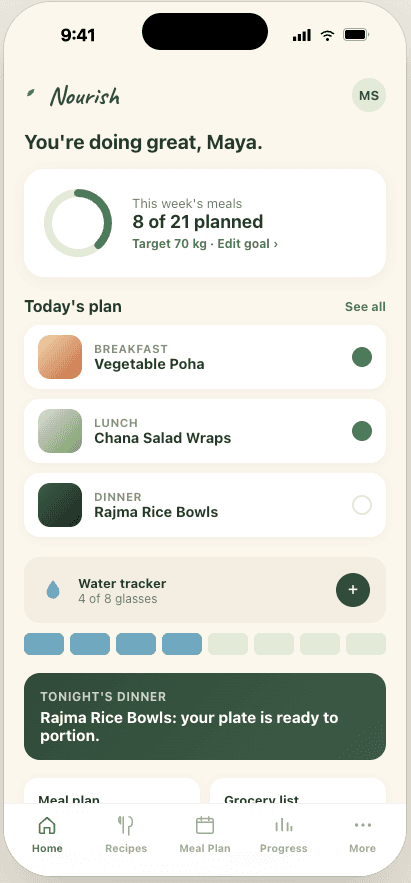
The home screen leads with progress toward a weekly meal target ('8 of 21 planned') and a named weight goal — making the plan feel personal, not generic. Today's meals are surfaced immediately: Vegetable Poha, Chana Salad Wraps, Rajma Rice Bowls — real foods from the local kitchen, not aspirational substitutes. A water tracker and a dinner reminder round out the daily view without adding noise.
Weekly meal plan with budget tracking
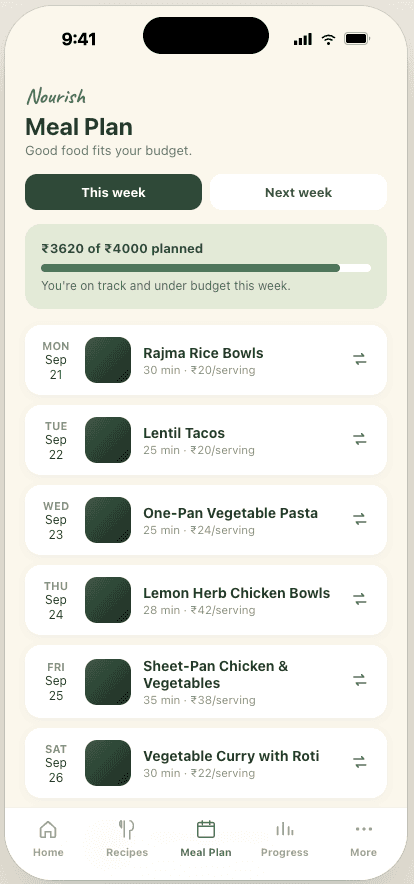
The Meal Plan tab shows the full week with a budget progress bar at the top: ₹3,620 of ₹4,000 planned, with a confirmation that the user is on track. Each day lists the main meal with prep time and cost per serving — making it easy to see not just what to cook but whether it fits the week's spend. Budget is a first-class constraint here, not a footnote.
Budget-friendly recipe discovery
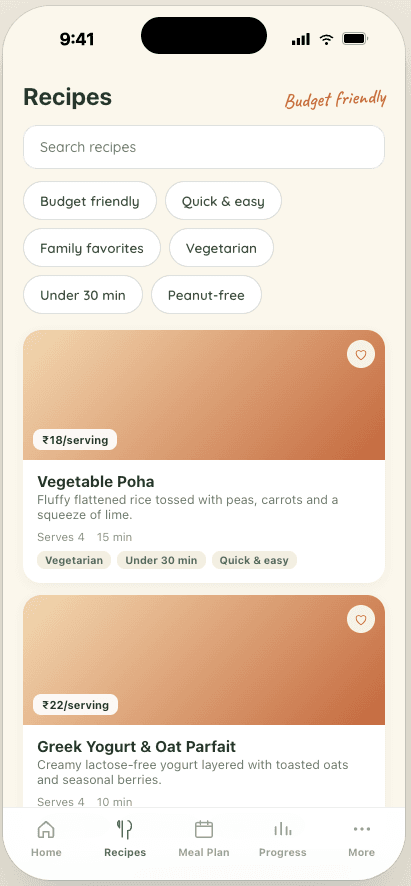
The Recipes screen leads with a 'Budget friendly' filter and surfaces cost per serving (₹18, ₹22) as a primary label on each card — before the recipe name, before the cook time. Familiar dishes (Vegetable Poha, Greek Yogurt & Oat Parfait) make the library feel achievable. Filter chips (Quick & easy, Vegetarian, Under 30 min) let users narrow without needing to search.
Progress tracking over time
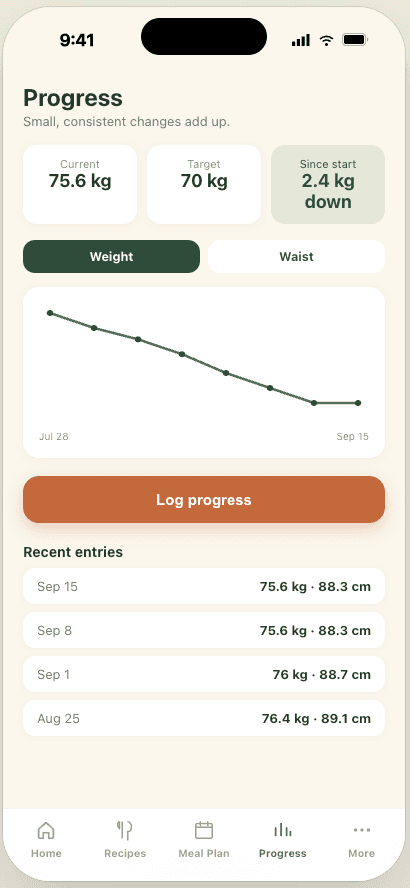
The Progress screen tracks weight and waist over time with a simple line chart. The headline is the delta — '2.4 kg down since start' — not the current number alone. Weight and waist toggle sits above the chart; recent entries are listed below as a plain log. The framing is consistent and encouraging: 'Small, consistent changes add up.'
Constraints that preserved the premise.
Three features that would have contradicted the product’s core promise.
- 01
No supplement or product upsells
Recommending protein powder, meal replacements, or branded supplements would contradict the core premise: that a healthy diet is achievable with everyday food at a normal grocery budget. The product earns trust by not selling anything.
- 02
No family-separate meal versions
A 'diet version' of the family dinner creates social friction, additional cooking effort, and visible othering. If a meal suggestion cannot be served to the whole household without modification, it is not included.
- 03
No rigid daily calorie targets
Calorie targets create an arithmetic relationship with food that most people cannot maintain long term. Nourish uses budget and protein as its two primary levers — both are practical, actionable, and do not require measuring every ingredient.
The thinking behind the concept.
- 01Affordability is not a constraint to work around — it is the design surface. A plan that ignores budget is not a plan for most people.
- 02Sustainability beats optimisation. A moderately good diet followed for three years produces better outcomes than a perfect diet followed for three weeks.
- 03The goal is a habit, not a result. The product should feel easier to use on week twelve than on week one — not harder.